

Table of Contents
- Affordable Jewelry That Does Not Tarnish: What to Look For
- Best Metals for Sensitive Skin: Nickel-Free Options
- Tarnish-Resistant Statement Pieces Worth Buying
- Jewelry Care Tips for Longevity: Keep Your Pieces Looking New
- How to Spot Low-Quality Jewelry Before You Buy
- Conclusion: Building a Tarnish-Free Collection on a Budget
- Frequently Asked Questions
Last Updated: October 3, 2026
Affordable Jewelry That Does Not Tarnish: What to Look For
The trick to affordable jewelry that does not tarnish is simple: buy pieces with a thick, well-bonded layer of a precious metal over a base that resists corrosion.
Tarnish is the discoloration that forms when a metal reacts with oxygen, sulfur, and moisture in the air. It is a surface reaction, not a defect.
Three things decide whether a piece tarnishes:
- The base metal. Brass and copper corrode fast. Stainless steel and sterling silver resist longer.
- The coating. Plating thickness and bond quality matter more than the label.
- How you wear it. Sweat, perfume, and water speed up the reaction.
The FTC's Jewelry Guides on precious metal claims set the rules brands must follow when they describe plating and gold content. Those rules exist because "gold plated" can mean almost anything without them.
Below, we break down which materials actually resist tarnish, how to spot weak construction before you buy, and how to keep affordable pieces looking new.
Why Some Metals Tarnish and Others Don't
Tarnish is oxidation, and oxidation needs a trigger. Silver reacts with sulfur compounds in the air. Copper and brass react with oxygen and moisture.
That is why a solid gold ring can sit in a drawer for decades and stay bright, while a copper bracelet turns dark in a humid bathroom.
Plating solves this by putting a non-reactive metal on top of a reactive one.
Best Metals for Sensitive Skin: Nickel-Free Options
Nickel is the most common cause of jewelry skin reactions, and it hides in a lot of "hypoallergenic" pieces. The safest choices for sensitive skin are nickel-free and lead-free metals: rhodium-plated finishes, 18K gold plating over a nickel-free base, sterling silver, and stainless steel.
Hypoallergenic means a piece is made to reduce the chance of an allergic reaction. It is not a regulated term, so any brand can print it on a label. That is why you should look for the specific claim: nickel-free and lead-free.
Why Tarnish and Skin Reactions Often Travel Together
The connection most guides miss: the same metals that tarnish fastest are usually the ones that trigger reactions. Copper and brass corrode easily, and the corrosion products, copper salts and nickel released from plating, are exactly what irritate skin.
That means a piece that resists tarnish is often, by chemistry, a better bet for sensitive skin. The two goals overlap more than they compete.
The Metals That Work for Reactive Skin
- Rhodium plating. Rhodium is a hard, bright metal in the platinum family. It does not trigger the nickel allergy that plated brass often does, and it resists tarnish on its own. The trade-off: rhodium plating is thin and can wear through at high-friction points, so it needs occasional replating.
- 18K gold over a nickel-free base. The gold layer blocks skin contact with the base metal. The base matters: gold over nickel-free brass or steel is safer than gold over a nickel-releasing alloy.
- Sterling silver. Nickel-free by definition, but it tarnishes, so it is not the best pick if your priority is a piece that stays bright without polishing.
How to Test a Piece Before You Commit
A common pattern among people with sensitive skin is reacting to a piece only after a full day of wear, not in the first few minutes. That is because reactions build with exposure time and moisture.
A practical approach:
Clara Chunky Teardrop Silver Hoop Earrings →
- Check the label first. Look for an explicit "nickel-free" and "lead-free" claim, not just "hypoallergenic."
- Do a wear test on a less sensitive spot. Wear the piece on your wrist or behind your ear for a full day before putting it against your neck or lobes. Reaction spots are thinner and more sensitive.
- Watch for the pattern, not just the redness. Itching, a green or black mark, or small bumps that appear hours later are the typical signs.
- Keep the piece dry during the test. Moisture and sweat accelerate both tarnish and nickel release, so a dry test is a conservative one.
If you have a known nickel allergy, a nickel-free claim from the brand is more reliable than a general "hypoallergenic" label, because the term is not regulated.
Our own earrings, including the Clara Chunky Teardrop Silver Hoop Earrings, are made lead-free and nickel-free with hypoallergenic materials. That matters if you have reacted to other brands before.

Clara Chunky Teardrop Silver Hoop Earrings
Tarnish-Resistant Statement Pieces Worth Buying
Statement jewelry does not have to mean heavy, and it does not have to mean fragile. The best tarnish-resistant pieces combine a corrosion-resistant finish with lightweight construction, so you can wear them through a full workday without discomfort.
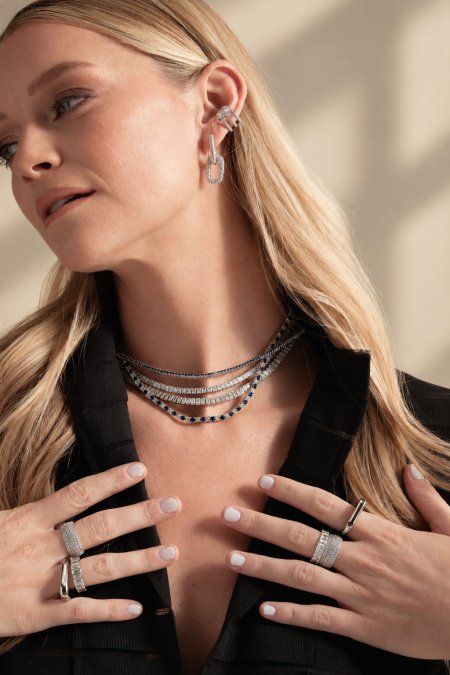
Woman wearing a chunky silver open cuff bracelet and sculptural ring with a hammered, high-polish finish.
Start with the finish. A high-polish surface reflects light evenly, which makes a piece look more expensive than it is. Then check the weight.
Earrings That Stay Bright Through Daily Wear
Earrings take the most abuse of any piece because they sit against skin, hair, and perfume all day. Look for post-back closures, a nickel-free finish, and a lightweight build.
The Emma Chunky Hammered Silver Hoop Earrings use an 8 mm sculptural profile with a hammered, high-polish finish. The Mia Chunky Silver J-Hoop Statement Earrings take the same approach with a lighter 5 mm thickness, so they stay comfortable for hours.


For something bolder, the Giselle Organic Pebble Silver Statement Earrings pair a 14 mm dome profile with a textured surface. The Nathalia Hammered Organic Silver Statement Earrings and the Sara Organic Square Silver Statement Earrings both use a hammered finish that reflects light from multiple angles, which keeps them looking bright even as the surface ages. The Mary Organic Donut Silver Statement Earrings round out the group with an 8 mm open-circle silhouette.
Cuffs and Rings Built for Long-Term Wear
Cuffs and rings need a finish that survives friction. An open cuff avoids the clasp problem entirely, since there is nothing to wear out or break.
The Nathalia Organic Textured Silver Open Cuff Bracelet uses a 12 mm sculptural profile with a hammered texture and a polished interior that sits smoothly against the wrist. The Nathalia Organic Textured Gold Open Cuff Bracelet offers the same build in an 18K gold plated finish. For rings, the Stella Chunky Dome Gold Statement Ring uses an 8 mm thickness with a mirror-polished finish and no engraved texture, so there are fewer spots for grime to collect.
Jewelry Care Tips for Longevity: Keep Your Pieces Looking New
Jewelry care tips for longevity come down to four habits: keep pieces dry, put them on last, store them separately, and clean them gently. These steps cost nothing and add years to a plated or gold-filled piece.
- Put jewelry on last. Perfume, lotion, and hairspray leave a residue that traps moisture and speeds up tarnish. Let each product dry before you put the piece on.
- Take it off first. Remove jewelry before you shower, swim, or clean. Chlorine and salt water are hard on plated finishes.
- Wipe after wear. A soft dry cloth removes oils and sweat before they sit overnight.
- Store pieces apart. A soft pouch or a lined box stops pieces from scratching each other. Humidity is the enemy, so skip the bathroom drawer.
- Clean gently. Warm water with a drop of mild soap, a soft cloth, and a full dry. Skip abrasive polishes on plated surfaces.
For deeper cleaning guidance, the American Gem Society's jewelry cleaning guidance covers what is safe for different metals and finishes.
How to Spot Low-Quality Jewelry Before You Buy
You can often tell a piece will tarnish early before you ever wear it. The warning signs are consistent.
- No material disclosure. If the listing does not name the base metal and the finish, assume the worst.
- No plating thickness. A brand that knows its microns will state them.
- "Gold tone" with no base metal named. This usually means a thin flash over brass
A quick test at home: hold the piece under bright light and check the edges and inner curves. If the finish looks uneven or thin at the contact points, that is where it will fail first.
Conclusion: Building a Tarnish-Free Collection on a Budget
Building a collection that resists tarnish is about choosing the right finish, not spending more. Focus on nickel-free and lead-free construction, a stated plating thickness, and a finish that hides wear rather than exposing it.
At Denise Pacini, we design statement pieces with exactly that in mind: hypoallergenic, lead-free and nickel-free materials, lightweight construction for extended wear, and 18K gold plated or rhodium plated finishes across sculptural designs. Explore the Denise Pacini collection and find a piece that holds its shine as long as you do.
Frequently Asked Questions
What type of jewelry will not tarnish?
Jewelry made from solid gold, stainless steel, titanium, or rhodium-plated pieces resists tarnishing best. Gold-filled jewelry also holds up well because the gold layer is bonded to the base metal. For affordable options, look for pieces with thick plating (measured in microns) and a protective coating. Rhodium-plated and 18K gold-plated jewelry from Denise Pacini uses lead- and nickel-free materials that resist oxidation with proper care.
Does gold-plated jewelry tarnish over time?
Gold-plated jewelry can tarnish when the thin gold layer wears away and exposes the base metal underneath. The plating thickness matters: 5 microns lasts longer than 0.5 microns. To extend the life of gold-plated pieces, keep them away from water, perfume, and lotions. Store them in a dry pouch and wipe them with a soft cloth after wearing. With careful handling, quality gold-plated jewelry can stay bright for years.
What is the difference between gold-filled and gold-plated jewelry?
Gold-filled jewelry has a thick layer of gold mechanically bonded to a base metal core, usually brass. The gold layer is a significant percentage of the total weight, so it resists wear and tarnishing far longer. Gold-plated jewelry has a microscopic gold layer applied through electroplating. Gold-filled costs more but lasts longer. Gold-plated is more affordable and works well for occasional wear or if you rotate your pieces often.
Is stainless steel jewelry a good option for sensitive skin?
Yes, stainless steel is a strong choice for sensitive skin. It is nickel-free in most jewelry grades, resistant to rust and corrosion, and does not tarnish easily. It also holds up to daily wear, including hand washing and light moisture. The trade-off is that stainless steel has a specific color and weight that may not suit every style. For a warmer tone with similar skin-friendly properties, look for rhodium-plated or 18K gold-plated pieces that are labeled lead- and nickel-free.
How do you care for affordable jewelry to prevent tarnishing?
Put jewelry on last, after lotions and perfume have dried. Take it off before swimming, showering, or exercising. Wipe each piece with a soft dry cloth after wearing to remove oils and moisture. Store pieces separately in airtight pouches or a lined jewelry box to limit air exposure. For plated jewelry, avoid abrasive cleaners and ultrasonic machines. Following these jewelry care tips for longevity keeps affordable pieces looking polished for years.